How Georgia handles shipping container homes: the mandatory 2024 state codes, the state definition of a shipping container building module, Savannah rules, septic permits and owner-builder limits.
Georgia sets a mandatory minimum building code for the whole state, and cities and counties decide whether to enforce it locally and how to zone. Its factory-built rules define a shipping container building module. Of the places we checked, Savannah has the most explicit container language in its zoning text.
The 2024 IBC and IRC with Georgia amendments became mandatory state codes on January 1, 2026.
Those codes apply to all construction, whether or not the local government enforces them.
Georgia’s rules define a Shipping Container Building Module for the factory-built program.
Savannah says shipping containers may not be used as ADUs, and we could not confirm the final text of its November 2025 ADU amendment.
We found no statewide ADU law, and owner-builders who build on their own land for their own use or occupancy need no contractor license.
State building codes
The Department of Community Affairs adopted the 2024 International Building Code and the 2024 International Residential Code, each with Georgia amendments, as mandatory state codes effective January 1, 2026, together with the 2023 NEC and the 2024 fire, mechanical, plumbing, fuel gas and swimming pool codes. Under O.C.G.A. 8-2-25 the mandatory state minimum codes have statewide application without local adoption, and counties and municipalities are authorized, but not required, to enforce them. A local government that does enforce them must use the latest editions and DCA’s amendments, and it may add stricter local amendments for climatic, geologic, topographic or public safety reasons, which are reviewed by DCA. DCA has also published a notice proposing new Georgia amendments to the 2024 IBC, the 2024 IEBC and the 2024 IPMC for January 1, 2027. The notice does not propose a new residential code. The Board of Community Affairs is due to consider adoption on November 19, 2026.
In the parts of DCA’s 2024 IRC amendment packet that we could read, only one item within Section R301 is changed, and we found no amendment to the climatic table or to the model code provision on intermodal shipping containers. We could not run a full-text search of the packets, so treat this as a pointer. Wind, snow and frost design values appear to be set by each local jurisdiction, so ask the building department for its design criteria sheet.
Energy code
Georgia’s 2024 IRC amendments delete the energy chapter of the IRC and point to the Georgia State Minimum Standard Energy Code instead, which is the 2015 International Energy Conservation Code with Georgia supplements and amendments. The wall insulation for a steel-framed container home therefore comes from that energy code, not from the IRC. DCA’s list of codes adopted effective January 2026 contains no energy code, so the edition did not change in that round.
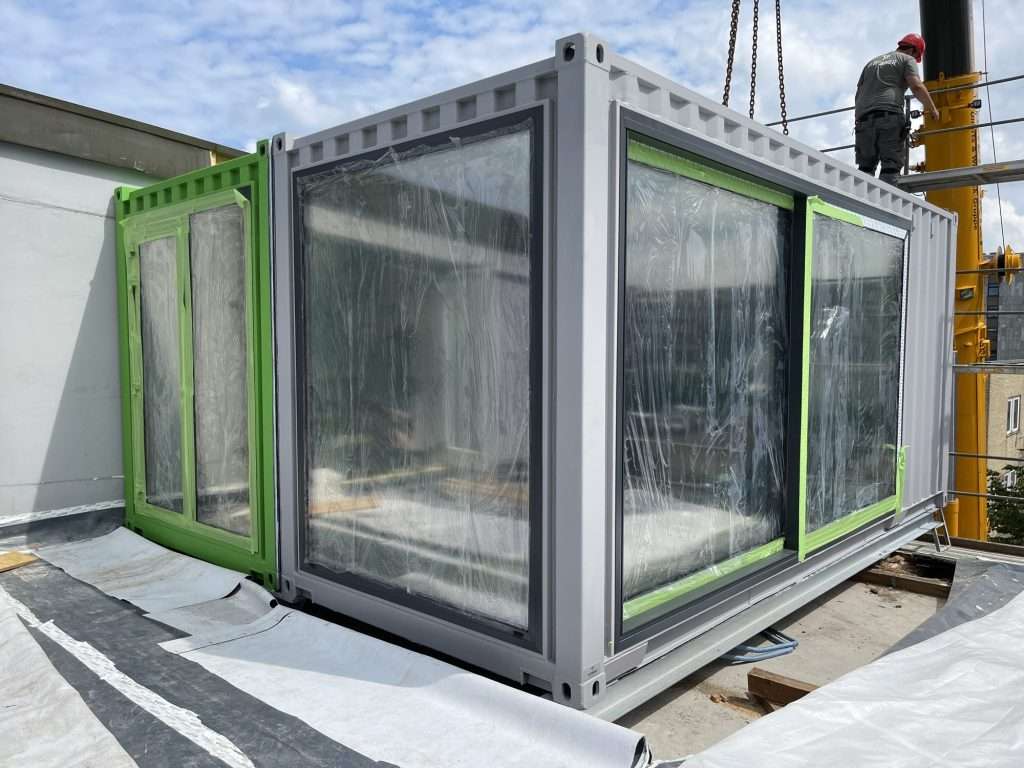
Andy explains how two shipping containers are connected to create one larger space.
The factory-built route
Georgia’s Industrialized Buildings Program, run by DCA, requires manufacturers of factory-built closed-construction buildings to obtain state approval of their manufacturing systems and quality control procedures. Manufactured HUD homes are excluded. The rules, Ga. Comp. R. & Regs. 110-2-2-.02, define a Shipping Container Building Module as a new or used container that an approved third-party agency has inspected, tested and certified under approved quality control and inspection protocols. They define a container as a single rigid, sealed, reusable metal box for shipping cargo, generally 10, 20, 30 or 40 feet long, built to ISO and ICSC standards. In the rules we read, the container-specific text is limited to these definitions, so the practical requirement comes from the general manufacturer approval and third-party certification system.
DCA states that zoning, setbacks and land use stay with the local government even for approved industrialized buildings, but a local government may not exclude one from a zoning district solely because it was built off site. Whether a one-off owner-built container needs approval under this program is not answered on DCA’s pages, so ask the department at codes@dca.ga.gov before you order a finished module.
Local rules
Place
What we found
Savannah
The version we could read (a 2023 Planning Commission exhibit) says shipping containers may not be used as ADUs and prohibits them as storage structures except on active construction sites or in industrial districts. City Council amended the ADU section on November 25, 2025, and we have not read the adopted text.
Unincorporated Chatham County
Houses and certain other structures in the flood zone must be built three feet above the 100-year base flood elevation.
Atlanta
We could not confirm the current adopted ADU limits or any container rule from the zoning ordinance. Ask the city planning department.
Fannin County
Building permit checklist lists setbacks of 15 feet from the property line and 50 feet from the road centerline, with septic handled by a separate office.
Augusta
Updating its zoning regulations for the first time since 1963. We found no container or ADU rule in the material we read.
Savannah’s text matters most. The ordinance as shown in the Planning Commission’s 2023 ADU exhibit says that manufactured homes, shipping containers, recreational vehicles and travel trailers shall not be used as accessory dwelling units. The city’s Metropolitan Planning Commission recommended approval of a new ADU amendment on October 28, 2025, loosening ADU standards for location, setbacks, size, lot area, architectural style and height, and City Council passed it 8 to 0 on November 25, 2025. We have not read the adopted text, so we cannot say whether the container sentence was kept. Ask the Metropolitan Planning Commission before you plan a container ADU in Savannah.
We found no statewide ADU law. House Bill 1166 of 2026 would have exempted dwellings of 400 square feet or less from local zoning decisions. It passed the House in March 2026, but we found no ADU act among the laws enacted in the 2026 session. Georgia Act 513, effective July 1, 2026, changes building permit procedures and requires local governments to provide real-time status information on permit applications.
Owner-builders
Georgia does not require a contractor license for a person to build their own home. The exemption in O.C.G.A. 43-41-17(h) covers a structure on land the person owns that is intended solely for that person’s own use or occupancy and not offered for sale or lease. The owner must personally supervise the work, and building and selling repeatedly within 24 months loses the exemption.
Septic, water and mountains
Under Department of Public Health Rule 511-3-1-.03, a construction permit from the County Health Department is required before starting a lot or structure that will use an on-site sewage system. The County Board of Health must approve or disapprove a completed application within twenty days, and the permit stays valid for at most twelve months. The same rule requires connection to a public or community sewage system if one is available within 200 feet of the property. The department’s manual for on-site sewage management gives recommended minimum lot sizes for a single-family home on septic of half an acre with public water and one acre with a private well, and counties may require more.
In the north Georgia mountains, the state’s Mountain Protection criteria apply to land 2,200 feet or more above mean sea level with a slope of 25 percent or greater for at least 500 feet horizontally. They limit single-family dwellings to one per acre, with exemptions for some older lots, structures to 40 feet above the crest, and tree removal during land disturbance to 50 percent of existing trees, unless a forester-prepared reforestation plan is filed. Local governments with a protected mountain must adopt them in a Mountain Protection Plan.
What containers cost in Georgia
These are median depot prices from our October 2026 price index. Each metro has at least three independent suppliers. Delivery is not included, and transport cost depends on distance from the depot. For site preparation see our foundation guide, and the build guide covers the order of work.
Metro
Used 20ft
Used 40ft high cube
New 20ft
Atlanta
$1,848
$2,450
$2,850
Savannah
$1,200
$2,249
$2,250
Listings
Containers for Georgia builds available now
Most container homes start with high cube containers, new or in premium used condition. Starting prices come from current inventory at US depots. Pick a container and vetted local suppliers send delivered quotes for your ZIP code.
Starting prices at the depot, based on current inventory at major US container depots. Delivery, sales tax and local fees are extra and depend on your ZIP code. Your supplier confirms the final price in your quote.
Container prices for your city, rule changes in your state, Andy’s newest videos and stock deals when we have them. One email a month, unsubscribe any time.
FAQs
Container homes in Georgia: frequently asked questions
01
We found no statewide ban in the state codes we read. Georgia’s mandatory state minimum codes apply to all construction, and a city or county may adopt its own zoning and ADU rules. Savannah is the strictest place we looked at. The version of its zoning ordinance we could read says shipping containers may not be used as accessory dwelling units and bars them as storage structures outside construction sites and industrial districts. City Council amended the ADU section in November 2025 and we have not read the adopted text.
02
Since January 1, 2026 the mandatory state codes include the 2024 International Building Code and 2024 International Residential Code with Georgia amendments, along with the 2023 NEC. They apply to all construction whether or not a city or county enforces them locally. According to DCA’s amendment document and the U.S. Department of Energy, the energy code is the 2015 IECC with Georgia amendments. DCA has proposed new Georgia amendments to the 2024 IBC, IEBC and IPMC for January 1, 2027.
03
Georgia’s Industrialized Buildings rules define a Shipping Container Building Module as a new or used container that an approved third-party agency has inspected, tested and certified under approved quality control and inspection protocols. That is the factory-built route. DCA’s pages do not say whether a container home built on site falls under this program, so ask DCA at codes@dca.ga.gov before you order a finished module.
04
Georgia does not require a contractor license for a person to build their own home. The exemption covers a structure on land you own that is intended solely for your own use or occupancy and not offered for sale or lease, and you must personally supervise the work. Building and selling repeatedly within 24 months loses the exemption.
05
A construction permit from the County Health Department is required before starting a lot or structure that will use an on-site sewage system, and the County Board of Health must approve or disapprove a completed application within twenty days. If a public or community sewer is available within 200 feet, you must connect to it.
06
In the October 2026 price index, the median depot price in Atlanta was $1,848 for a used 20ft container and $2,850 for a new 20ft. In Savannah it was $1,200 used and $2,250 new. Delivery is extra.
Andreas Atrott is the founder of CUBX - shipping-containers.com and its sister sites shipping-containers.com.au in Australia and containerbasis.de in Germany. He has spent more than 15 years in the container industry, across sales, modifications, and custom builds, and shares what he has learned on his YouTube channel, Andy Knows Containers. That practical experience shapes how the platform helps US buyers match the right container to their project.
A shipping container is the ultimate blank canvas. The design is clever, but at its core a container is a big steel box you can adapt almost any way you...
A standard shipping container, but taller: the premise behind ‘high cube’ units might be simple, but it makes this type of container particularly well suited to a range of applications....
Shipping containers are good for far more than moving freight across oceans. With the right accessories, you can turn a plain steel box into a storage unit, a site office,...
February 17, 2026
About Us
shipping-containers.com is an independent platform that makes buying a shipping container simple and transparent. Tell us what you need once, and vetted local suppliers across the US send you their quotes. One request, multiple quotes, no fees.
Got questions? Let’s chat.
We are here to make container buying simple. Talk to a real expert, get advice, and find your perfect fit, fast.
Hi, I'm Andy. 15+ years in containers. How can I help?
Shipping Container Homes in New York: Codes, NYC ADUs and Local Bans
How New York handles shipping container homes: the 2025 Uniform Code, NYC ancillary dwelling units, container laws in Buffalo, Sweden and Coxsackie, Adirondack Park review, septic and modular approval.
Shipping Container Homes in California: Codes, ADUs and City Rules
How California handles shipping container homes: the 2025 state codes, the LADBS conversion bulletin, San Diego rules, state ADU law, HCD approval for factory-built units and counties that allow containers only for storage.
Shipping Container Homes in Washington: Codes, ADUs and L&I Rules
How Washington handles shipping container homes: the 2021 state codes, Pierce, King and Ferndale container rules, the two-ADU state law, the energy code wall U-factor and the L&I factory-assembled program.