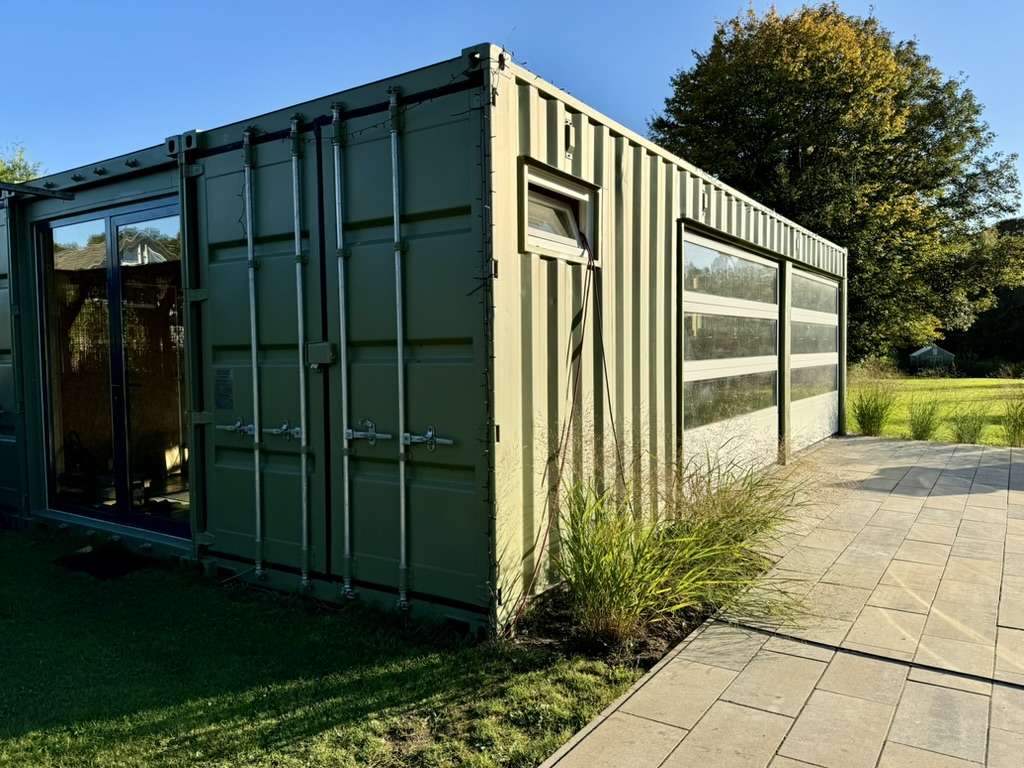
How Arizona handles shipping container homes: no statewide building code, county and city rules in Phoenix, Tucson, Maricopa and Yavapai, the 2025 county ADU law, water and septic.
Arizona leaves building codes to counties and cities. Counties may adopt and enforce a code for zoned areas, and may exempt rural or unclassified land, so a container home in Phoenix, in Pima County and on a ranch parcel in a rural county can face three different sets of rules. Arizona also requires larger cities, and since 2025 counties, to allow accessory dwellings.
Arizona leaves building codes to counties and cities. Phoenix, Tucson and Pima County use the 2024 codes. Maricopa County and Yavapai County use 2018 codes.
Maricopa County added the model code section on intermodal shipping containers to its code, and a permanent container building needs a foundation designed under the structural chapters and a structural analysis, unless it qualifies for the simplified design in that section.
Cities over 75,000 residents must allow an attached and a detached ADU, and since 2025 counties must as well.
Phoenix dropped the permit for storage containers in August 2025. Tucson still requires one for any container.
Rural lots need a water plan: exempt wells are limited to 35 gallons per minute, and some subdivisions have no assured water supply.
Who decides: state, county or city
Arizona law lets a county board of supervisors adopt and enforce a building code for zoned unincorporated areas, and lets it exempt areas zoned rural or unclassified. A county can take its code from a national code organization or from the largest city in the county. So whether a container home is inspected at all in unincorporated Arizona depends on the county and on how the parcel is zoned. Do not assume that no code means no permit: zoning, septic and floodplain rules can still apply.
Place
Code and container rules
Phoenix
2024 IBC and IRC with Phoenix amendments, effective August 1, 2025. No permit needed for storage containers since that date.
Tucson
2024 IBC and IRC since January 1, 2026. A permit is required to place any shipping container.
Pima County
2024 codes since January 1, 2026.
Maricopa County (unincorporated)
2018 codes plus a local addition for intermodal shipping containers.
Yavapai County (unincorporated)
2018 codes. Steel storage containers allowed only for personal storage, in RMM or less restrictive zoning districts, with a permit.
Colorado City (Mohave County)
Cargo containers are an accessory use that needs a permit, and may not be connected to utilities. The same section says it does not prevent using cargo containers for construction.
The most specific rule we found is in Maricopa County. Its Local Additions and Addenda of September 2022 add the intermodal container section of the 2021 International Building Code to the county’s 2018 code. A permanent container building has to sit on a foundation designed under the structural chapters of the code, and the building official needs a structural analysis, unless the container is designed under the simplified provision in that section. Pima County and Tucson are on the 2024 codes. Ask the building department whether and how it applies any provisions on shipping containers.
Read the Phoenix change carefully. With the 2024 Phoenix Building Construction Code, which took effect on August 1, 2025, the city no longer requires a permit for storage shipping containers. That concerns storage only. It does not cover a container used as a dwelling, so ask Phoenix Planning and Development what applies. We found no Phoenix zoning rule written specifically for container ADUs, and the city’s zoning FAQ refers shipping container questions to the Zoning Division. Yavapai County allows steel storage containers only to store personal items, with a permit, and it allows small site-built homes that meet the codes and carry building permits.
Andy explains the insulation mistake that causes hidden rust in shipping containers.
ADU law: what changed in 2025
Under ARS 9-461.18, a city with more than 75,000 residents must allow at least one attached and one detached accessory dwelling as a permitted use on any lot where a single-family home is allowed. The size limit is 75 percent of the main house or 1,000 square feet, whichever is less. A city may not require the ADU to match the main house in exterior design, roof pitch or finish, and may not require it to meet a commercial building code or carry a fire sprinkler, although building, fire and health codes still apply. As of October 2026, a city that had not adopted compliant rules by January 1, 2025 has to allow ADUs on residential lots without local limits, except for land near certain military and public airports.
Counties followed in 2025. HB 2928, signed on May 23, 2025, added ARS 11-810.01, which requires counties to allow at least one attached and one detached ADU on any lot where a single-family home is allowed, plus a second detached one on lots of one acre or more. The default date for counties was January 1, 2026. Where an ADU will not connect to sewer, a county can require a properly sized septic system first. Cities and counties may require the owner to live on the property when an ADU built on or after September 14, 2024 is used as a short-term rental.
Phoenix applies this with a size cap of 1,000 square feet or 75 percent of the main house on lots up to 10,000 square feet, a height limit of 15 feet unless a use permit is granted, and a minimum distance of 3 feet from an interior property line. Tucson requires a permit for any building used as a home, including detached accessory dwellings.
Wind, soil and flood
The climate tables in local codes show how much the design values differ across the state. Phoenix lists a 105 mph design wind speed, Seismic Design Category B, a frost line of 0 and a termite risk of moderate to heavy. Maricopa County lists 115 mph for the same table. Pima County lists 105 mph, Seismic Design Category B and a frost depth of 0 inches up to 4,000 feet elevation and 24 inches above it. Use the values from the jurisdiction that will issue your permit, not a state average.
The University of Arizona’s geological survey notes that damage to structures in Arizona is commonly related to soil, and describes expansive and collapsible soils that crack foundations and slabs. A container on piers or pads can move on expansive or collapsible soil, so ask an engineer to assess the soil before choosing the foundation, see our foundation guide. State law also requires counties and flood control districts to put the lowest floor of a residential structure in a floodplain at or above the regulatory flood elevation, which matters in washes and monsoon country.
Water and septic on rural land
An exempt well in Arizona is limited to a pump capacity of 35 gallons per minute, and a notice of intention to drill must be filed with the Department of Water Resources before drilling. Since 2006 a new exempt well may not be drilled on land within 100 feet of a qualifying municipal water system, unless an exception applies. Outside active management areas the state reviews whether a subdivision has an adequate water supply, meaning available for at least 100 years, and when a subdivision of six or more lots lacks one, that must be shown in the sales material. Ask for that report before buying a rural lot.
Onsite wastewater is regulated by the Department of Environmental Quality through general permits under Title 18, Chapter 9 of the Administrative Code. The department delegates some of the permitting to local authorities, so a rural application may go to the county.
Factory-built and owner-built
The Office of Manufactured Housing in the Arizona Department of Housing enforces standards for manufactured homes, factory-built buildings and accessory structures, including their installation. A factory-built building is one made wholly or largely off site and finished on site under adopted codes. Arizona exempts owners who build on their own property for their own occupancy from contractor licensing, but selling or renting the structure within one year after completion is treated as evidence that it was built for sale or rent. Our build guide covers the order of work.
What containers cost in Arizona
These are median depot prices from our October 2026 price index. A metro appears only when at least two independent suppliers priced the container. For Tucson, and for used 20ft and used 40ft high cube containers in Phoenix, we have only one supplier, so we show no median. Delivery is not included, and transport cost depends on how far the depot is from your site.
Metro
New 20ft
New 40ft high cube
Phoenix
$3,322
$5,045
Listings
Containers for Arizona home builds available now
Most container homes start with high cube containers, new or in premium used condition. Starting prices come from current inventory at US depots. Pick a container and vetted local suppliers send delivered quotes for your ZIP code.
Starting prices at the depot, based on current inventory at major US container depots. Delivery, sales tax and local fees are extra and depend on your ZIP code. Your supplier confirms the final price in your quote.
Container prices for your city, rule changes in your state, Andy’s newest videos and stock deals when we have them. One email a month, unsubscribe any time.
FAQs
Container homes in Arizona: frequently asked questions
01
Arizona leaves building codes to counties and cities, so legality depends on the county or city. Phoenix and Tucson enforce the 2024 International codes, Maricopa County has added the model code section on intermodal containers to its 2018 code, and Yavapai County allows steel storage containers only for personal storage, with a permit, and small site-built homes that meet the codes. Where a building code applies, a container home needs plans and a permit, and Maricopa County adds container-specific requirements.
02
It depends on the place and the use. Phoenix stopped requiring a permit for storage shipping containers on August 1, 2025, but that does not cover a container used as a dwelling. Tucson requires a permit to place a container on a property whatever it is used for. Yavapai County requires a permit for a storage container.
03
Arizona law requires larger cities and counties to allow ADUs. Whether a container ADU is approved still depends on the building code and local rules. Cities with more than 75,000 residents must allow at least one attached and one detached accessory dwelling on lots with a single-family home, and since 2025 counties must too. A city cannot require an ADU to match the main house, and neither a city nor a county can require a fire sprinkler, but building, fire and health codes still apply.
04
If a rural lot has no water or sewer connection, it needs a water source and a septic system. An exempt well is limited to 35 gallons per minute and needs a notice of intention to drill with the Department of Water Resources. Onsite wastewater is regulated by the Department of Environmental Quality, which delegates some permitting to local authorities, so your septic application may go to the county.
05
Phoenix amends the energy code, but the amendments we saw do not change wall R-values, so ask the building department what the current requirement is for your wall assembly.
06
In the October 2026 price index, the median depot price for a new 20ft container was $3,322 in Phoenix, and a new 40ft high cube was $5,045. Delivery is extra.
Andreas Atrott is the founder of CUBX - shipping-containers.com and its sister sites shipping-containers.com.au in Australia and containerbasis.de in Germany. He has spent more than 15 years in the container industry, across sales, modifications, and custom builds, and shares what he has learned on his YouTube channel, Andy Knows Containers. That practical experience shapes how the platform helps US buyers match the right container to their project.
A shipping container is the ultimate blank canvas. The design is clever, but at its core a container is a big steel box you can adapt almost any way you...
A standard shipping container, but taller: the premise behind ‘high cube’ units might be simple, but it makes this type of container particularly well suited to a range of applications....
Shipping containers are good for far more than moving freight across oceans. With the right accessories, you can turn a plain steel box into a storage unit, a site office,...
February 17, 2026
About Us
shipping-containers.com is an independent platform that makes buying a shipping container simple and transparent. Tell us what you need once, and vetted local suppliers across the US send you their quotes. One request, multiple quotes, no fees.
Got questions? Let’s chat.
We are here to make container buying simple. Talk to a real expert, get advice, and find your perfect fit, fast.
Hi, I'm Andy. 15+ years in containers. How can I help?
Shipping Container Homes in New York: Codes, NYC ADUs and Local Bans
How New York handles shipping container homes: the 2025 Uniform Code, NYC ancillary dwelling units, container laws in Buffalo, Sweden and Coxsackie, Adirondack Park review, septic and modular approval.
Shipping Container Homes in California: Codes, ADUs and City Rules
How California handles shipping container homes: the 2025 state codes, the LADBS conversion bulletin, San Diego rules, state ADU law, HCD approval for factory-built units and counties that allow containers only for storage.
Shipping Container Homes in Washington: Codes, ADUs and L&I Rules
How Washington handles shipping container homes: the 2021 state codes, Pierce, King and Ferndale container rules, the two-ADU state law, the energy code wall U-factor and the L&I factory-assembled program.